Journal · Toys · Safety guide
Are Nylabones safe for puppies? Chew toy safety, lifespan, and when to replace
Short version: a chew toy is only as safe as its fit — the right hardness, a size bigger than the mouth, supervision, and a toy that gets binned before pieces go missing. Below are straight answers to the questions people ask most, each tied to a vet or maker source you can check.
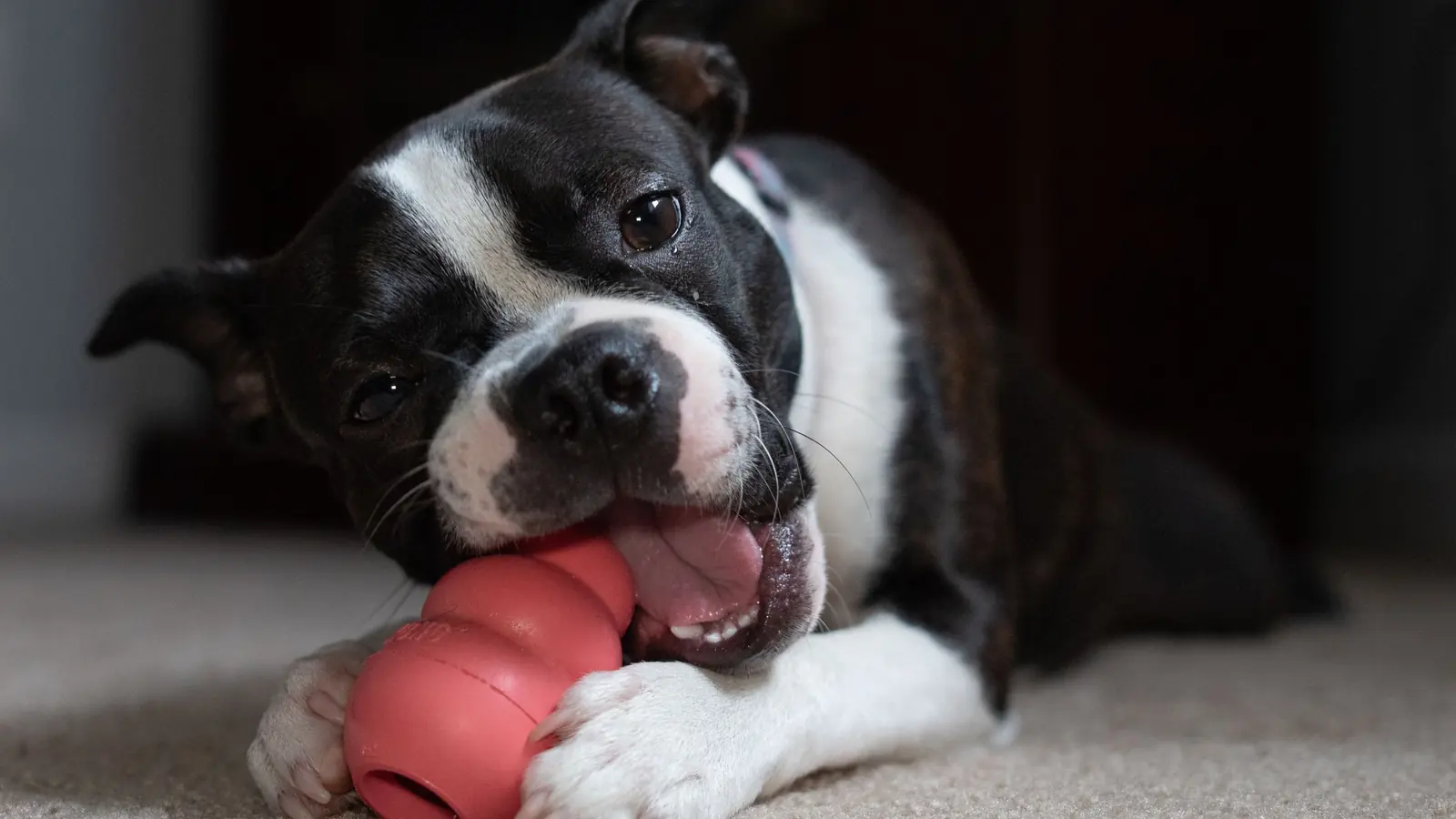
Quick answer
Nylabone makes a softer Puppy Chew line and says to choose by age, weight, and chew strength and to always supervise, but VCA’s puppy guidance says to generally avoid extremely hard chews like nylon, bones, or antlers because they can fracture new teeth. A safe chew should dent with your thumbnail, bend slightly, and not hurt if it hit your kneecap, and it should never be small enough to fit entirely in your dog’s mouth. Chew toys have no fixed lifespan, so inspect before every session and replace at the first crack, missing chunk, worn-down end, or frayed rope. If your dog swallows a chunk, take the toy away and call your vet right away, and don’t make your dog vomit unless the vet tells you to.
How this was made: we read veterinary sources (VCA Animal Hospitals, AAHA, the ASPCA, the American College of Veterinary Surgeons, a board-certified veterinary dentist’s column) and the maker’s own instructions. We did not run chew tests. This is general information, not veterinary advice — your vet knows your dog’s mouth. More on our process: how we research.
Quick answers
| Question | Short answer | Source |
|---|---|---|
| Are Nylabones safe for puppies? | Only a puppy-rated line, sized up, supervised. VCA advises avoiding extremely hard chews such as nylon for teething puppies. | VCA, Nylabone |
| How long does a nylon chew last? | No fixed lifespan — weeks for one dog, months for another. Replace when ends wear down, it cracks, or it gets small. | Nylabone FAQ, ASPCA |
| How often to rotate chew toys? | About every couple of days, to keep interest up. | ASPCA |
| How often to replace? | On condition, not on a schedule. Inspect before every session. | Nylabone FAQ, VCA |
| Dog swallowed a chunk? | Remove the toy, call your vet now. Don’t induce vomiting unless the vet says to. | ASPCA, VCA |
| What materials do vets suggest? | Anything that passes the thumbnail-dent, bend, and kneecap tests; nothing that fits entirely in the mouth. | VCA, AAHA, VPN |
Are Nylabone chews safe for puppies?
They can be used safely only in the puppy-rated line, sized up, and supervised — and some vets would avoid hard nylon for puppies altogether. The two kinds of source disagree a little, so here is each one plainly.
- What Nylabone says. Its guidelines for use say to pick the chew by age, weight, and chew strength; to choose one large enough that the dog chews from the side rather than top-to-bottom; to always supervise puppies so they can’t bite off large pieces; and to replace the chew when it is damaged, the ends are worn down, or it becomes too small. Its FAQ says the Puppy Chew line is its softest formulation and won’t stand up to adult jaws. Its Puppy Power Chew line is meant for strong chewers or puppies with any adult teeth, and it notes puppies usually finish switching to adult teeth between six and eight months.
- What vets say. VCA’s puppy teething guide says to generally avoid anything extremely hard, “such as nylon, bones or antlers,” because of the risk of fracturing new teeth, and to choose toys that bend a little or that you can indent with a fingernail. VCA’s fractured-teeth article (co-written by a board-certified veterinary dentist) lists nylon chews among the items to eliminate to prevent more broken teeth.
A practical way to reconcile them: run the thumbnail test on the exact chew in your hand. A soft puppy formula that dents may pass; a hard adult nylon bone will not. If it fails, or your puppy is chewing pieces off, swap it for something with more give and ask your vet.
How long do Nylabone (nylon) chew toys last?
There is no honest number — it depends on the dog. Nylabone’s own FAQ says there is “no fixed timeline” and the same chew can last months for one dog and need replacing within weeks for another. Anyone quoting a standard lifespan in weeks is guessing.
What matters is how it wears. The ASPCA’s position statement on chews explains that dogs slowly wear down the ends of durable nylon chews, “resulting in thin sections that can be broken off and swallowed,” and tells owners to discard these chews before they become excessively worn. Small raised bristles on the surface are normal, according to Nylabone; chunks coming off are not, and usually mean the chew is the wrong size or strength for that dog.
How often should chew toys be rotated or replaced?
Rotate every couple of days. Replace when the toy shows damage — never “when the month is up.”
The ASPCA’s destructive chewing guide says it is ideal to introduce something new or rotate chew toys every couple of days so a dog doesn’t get bored. Research backs up why novelty matters: in a 2012 study of 16 kennel-housed Labradors, dogs lost interest in a toy through habituation and played again when given a different toy. (That was a small kennel study, not a household trial, so treat it as support for rotating, not a prescription.)
Rotation also spreads wear across toys so each one fails more slowly. A simple routine:
- Keep two or three suitable toys out; store the rest.
- Swap the set every couple of days.
- Inspect each toy as it comes out and as it goes away — that’s your replace check (see the replace-when table).
Replace-when table: signs a chew toy is worn out
| Toy type | Replace or remove when… | Source |
|---|---|---|
| Nylon chew (e.g. Nylabone) | Ends or knuckles worn down, cracked, thin sections forming, chunks coming off, or now too small to chew from the side | Nylabone, ASPCA |
| Rubber chew or stuffable | Rubber is broken, a chunk is missing, or pieces are coming off | VCA, VCA puppy |
| Rope toy | Rope is frayed — loose strands can be swallowed | VCA |
| Plush or fabric | Stuffing is showing, or eyes, ribbons, or other parts are loose | VCA, AAHA |
| Hard plastic toy | It fragments at all — toys that break into swallowable pieces shouldn’t be offered | ASPCA |
| Tennis ball | Used as a long chew: the abrasive felt can wear teeth over time; keep it for fetch | VCA |
| Edible or compressed chew | Small enough to swallow whole, or your dog is gulping large chunks | ASPCA |
| Any toy | It now fits entirely in your dog’s mouth, or fails the thumbnail/bend test | VCA, AAHA |
Our free durability checklist puts these checks on one printable page.
What happens if my dog swallowed a chunk of Nylabone?
Call your veterinarian now, even if your dog seems fine. The ASPCA’s position statement tells owners to “immediately consult a veterinarian if their pet consumes a chunk of chew material,” and Nylabone’s instructions say to take the product away and contact your vet if you think a large piece was swallowed.
- Take the toy away and keep the remaining piece — it shows the vet roughly how much is missing.
- Call your vet or an emergency clinic. Say what the toy is made of, roughly how big the missing piece is, and when it happened.
- Don’t make your dog vomit unless the vet tells you to. VCA warns that home-induced vomiting can do more harm than good (VCA).
- Watch for warning signs and report them: vomiting, diarrhea, belly pain or tenderness, loss of appetite, straining to poop or passing little stool, lethargy, or growling when the belly is handled (VCA).
What happens next is the vet’s call. According to VCA and the American College of Veterinary Surgeons, small smooth items sometimes pass on their own with monitoring and follow-up X-rays. Others are removed with an endoscope or need surgery, and VCA describes foreign-body obstruction as one of the more common and potentially life-threatening problems vets see. Time matters, which is why the advice is to call rather than wait.
What chew toy materials do vets recommend?
Vets don’t point to a magic material. They give a hardness and size test, and a short list of things to avoid.
The hardness tests
- Thumbnail (fingernail) test: you should be able to leave a dent with your thumbnail. If you can’t, it’s too hard (VCA, AAHA).
- Bend test: long toys should bend a little between your hands (VCA, AAHA).
- Kneecap rule: if you wouldn’t want to be hit in the kneecap with it, your dog shouldn’t chew it. It comes from Canadian veterinary dentist Dr. Fraser Hale, as quoted by board-certified veterinary dentist Dr. John Lewis in Veterinary Practice News.
- Hammer test: if it’s hard enough to drive a nail, it’s too hard to chew (AAHA).
Size and design
- Never small enough to fit entirely in the mouth (VCA). AAHA suggests bigger than the snout and slightly wider than the mouth, and one size up for aggressive chewers (AAHA).
- No eyes, ribbons, or removable parts (VCA).
- For dental claims, look for the Veterinary Oral Health Council (VOHC) seal (VCA, AAHA).
Chew materials compared
| Material | Hardness verdict from vet sources | Main risk |
|---|---|---|
| Firm natural rubber / elastomer that dents | Fits the “has some give” guidance | Chunks if under-sized or the wrong strength; retire when broken |
| Hard nylon bones | Listed among items to eliminate to prevent broken teeth (VCA); avoid for puppies (VCA) | Tooth fracture; worn thin ends can break off (ASPCA) |
| Bones, antlers, hooves | Too hard (VCA, AAHA, VPN) | Tooth fracture |
| Yak milk chews, hard rawhide | Can damage or fracture teeth (AAHA) | Fracture; large swallowed pieces (ASPCA) |
| Ice cubes | Too hard as a chew (VCA, VPN) | Tooth fracture |
| Rope, plush | Soft enough, but not a chew for destroyers | Swallowed strands or stuffing |
Why hardness matters: VCA’s fractured-teeth article notes that the most commonly broken teeth are the canines and the big upper cheek teeth, often from chewing hard, non-bending items, and a broken tooth with exposed pulp usually needs a root canal or extraction. For the eco side of this choice — natural rubber vs recyclable elastomers vs hemp — see our eco dog toys field guide.
Long-lasting chews for aggressive chewers: the trade-off
The toys that last longest are often the hardest, and hardness is what breaks teeth. That tension is why we argue there is no such thing as an indestructible dog toy — a point Dr. Lewis makes too in Veterinary Practice News. For power chewers, the better target is a thick one-piece toy that still dents, sized up, used under supervision, and retired on condition. Our guide to toys for aggressive chewers sorts materials by chew style.
Common questions
Are Nylabone chews safe for puppies?
Only the right line, sized up and supervised — and some vets would skip hard nylon entirely. Nylabone makes a softer Puppy Chew line for teething puppies and says to always supervise, choose by age, weight and chew strength, and replace the chew when ends wear down. VCA’s puppy-teething guidance says to generally avoid anything extremely hard, such as nylon, bones or antlers, because they can fracture new teeth, and to pick toys that bend a little or that you can dent with a fingernail. If your puppy’s chew fails that fingernail test, ask your vet before using it.
How long do Nylabone chew toys last?
There is no fixed lifespan. Nylabone’s own FAQ says the same chew can last months for one dog and need replacing within weeks for another, so judge the toy, not the calendar. Replace it when the ends or knuckles are worn down, it is cracked, or it has become too small to chew safely. The ASPCA notes that durable nylon chews wear down into thin sections that can break off, and says to discard them before they become excessively worn.
How often should chew toys be rotated or replaced?
Rotate every couple of days; replace on condition. The ASPCA suggests introducing something new or rotating chew toys every couple of days so a dog doesn’t get bored. Replacement has no safe calendar interval: inspect before every session and retire a toy at the first missing chunk, crack, frayed rope, exposed stuffing, or once it is small enough to fit entirely in your dog’s mouth.
What should I do if my dog swallowed a chunk of Nylabone or another chew toy?
Take the rest of the toy away and call your veterinarian now — don’t wait for symptoms. The ASPCA says to consult a veterinarian immediately if a dog consumes a chunk of chew material, and Nylabone gives the same instruction for a large piece. Do not make your dog vomit unless your vet tells you to. Signs of a possible blockage include vomiting, diarrhea, belly pain, loss of appetite, straining to poop, and lethargy (VCA).
What chew toy materials do vets recommend?
Vets describe a hardness test more than a brand: you should be able to dent the toy with a thumbnail, it should bend slightly, and it shouldn’t hurt if it hit your kneecap. VCA, AAHA and veterinary dentists list bones, antlers, hooves, hard nylon chews, and ice cubes as common causes of broken teeth. Look for firm-but-giving rubber sized larger than the mouth, and for dental products, the Veterinary Oral Health Council (VOHC) seal.
Sources
- VCA Animal Hospitals. How to choose the best chew toy for your dog. vcahospitals.com
- VCA Animal Hospitals. Dos and don’ts of puppy teething toys. vcahospitals.com
- Hunter T, Bellows J (Dipl. AVDC). Fractured teeth in dogs. VCA Animal Hospitals. vcahospitals.com
- Llera R, Hunter T, Ward E. Ingestion of foreign bodies in dogs. VCA Animal Hospitals. vcahospitals.com
- VCA Animal Hospitals. True or false: if your pet ate something toxic, you should make them vomit. vcahospitals.com
- American Animal Hospital Association. Don’t chew on this! (Apr 2024). aaha.org
- ASPCA. Position statement on dog chews/treats. aspca.org
- ASPCA. Destructive chewing. aspca.org
- American College of Veterinary Surgeons. Gastrointestinal foreign bodies. acvs.org
- Lewis J (Dipl. AVDC). Why you need to choose chew toys wisely. Veterinary Practice News, 2017. veterinarypracticenews.com
- Pullen AJ, Merrill RJN, Bradshaw JWS. Habituation and dishabituation during object play in kennel-housed dogs. Animal Cognition 2012;15(6):1143–50. PubMed
- Nylabone. Frequently asked questions; How to use Nylabone chew toys (maker guidance). FAQ · Guidelines
All sources accessed October 31, 2026. Nylabone is a maker source, not an independent one; we quote it for its own instructions.