Journal · Toys · Myth check
“Indestructible” dog toys: the claim vs reality
Every power-chewer owner has bought the toy that said indestructible and watched it lose a chunk by Thursday. The word is not a lie so much as a wish. Here is what to shop for instead: a toy that fits the dog, fails safely, and gets retired on time.
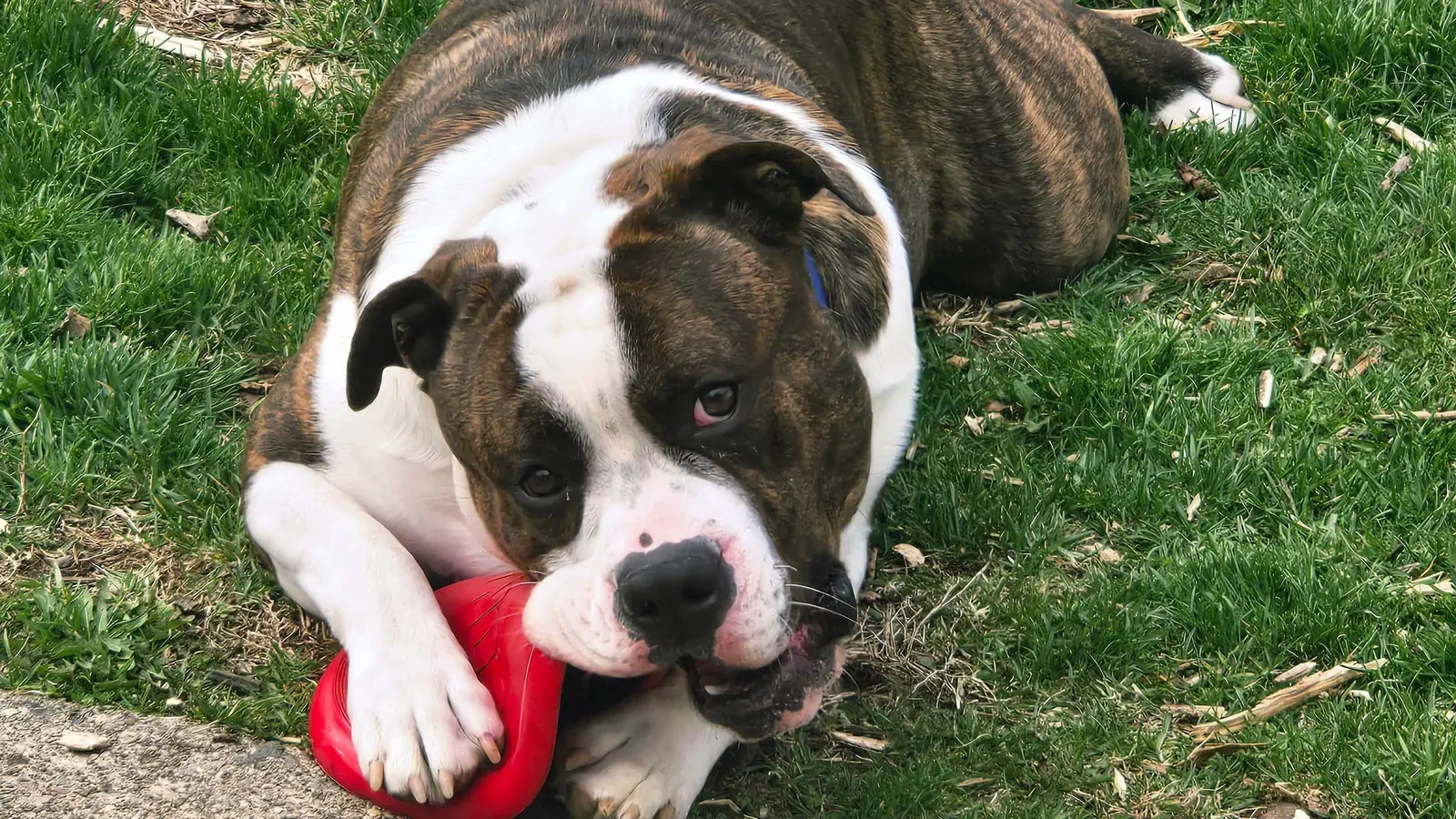
We have not run a destruction test, and we will not pretend a dog named Tank ate forty toys for this article. This is a framework built from how toys are labeled, how makers word their guarantees, and the safety guidance vets give about chew hardness. If you already know your dog is a power chewer, our guide to dog toys for aggressive chewers goes deeper on materials.
Why “indestructible” is a marketing word
There is no industry standard for “indestructible,” “ultra-tough,” or “for extreme chewers.” Nobody certifies those words. A brand can print them after testing with a handful of dogs, or after no testing at all. Meanwhile your dog brings variables no label can predict: jaw size, chew style, persistence, boredom, and how many unsupervised hours the toy gets.
Notice how the better makers word it. West Paw’s own guarantee page says plainly that it does not guarantee its toys are totally indestructible, because normal wear and tear is normal. That honesty is a better signal than a bigger adjective.
Reading durability claims: what each one really tells you
| Label says | What it can mean | What to check |
|---|---|---|
| “Indestructible” | Hope, or a toy that is very hard (which brings its own risk) | Hardness, chew rating, and whether a guarantee backs it |
| “Tough” / “for power chewers” | The maker’s own chew tier, usually from internal testing | Which tier your dog is in, and the size chart |
| Numbered toughness scale | A brand-internal ranking, comparable only within that brand | Do not compare a “9” from one brand to a “9” from another |
| “Guaranteed” | A replacement or refund policy with conditions | Time limit, how many replacements, receipt rules, shipping costs |
| “Natural,” “eco,” “biodegradable” | A material or disposal claim — nothing about chew strength | Our materials glossary |
Guarantees are a signal, not a shield
A real guarantee tells you the maker expects the toy to last and is willing to pay when it does not. Read the fine print, because the policies differ a lot. Two examples from makers’ own pages as of October 2026:
- West Paw (Zogoflex and other toys): one replacement per toy design, per household, within six months of purchase, with proof of purchase.
- Goughnuts: replaces toys a dog damages; you pay return shipping. Its solid rings have a red inner layer meant to show when to take the toy away.
A guarantee does not cover a swallowed piece or an emergency vet visit. The visible-failure idea behind Goughnuts’ red layer is the right instinct for any toy: you want a clear signal to retire it before pieces go missing.
The other risk: toys that are too hard
The obvious fix for a destroyer is “buy the hardest thing in the aisle.” That is how dogs end up with broken teeth. Very hard chews — some nylon bones, antlers, hooves, and real bones — are associated with fractured teeth, especially the big upper chewing teeth (the carnassials). A fractured tooth can expose the pulp, hurt, and need extraction or root-canal-type treatment.
Two quick rules of thumb many vets use:
- The fingernail test: if you cannot leave a slight dent with your fingernail, it is too hard for an enthusiastic chewer.
- The kneecap test: if it would hurt to be hit on the knee with it, it is too hard for your dog’s teeth.
The sweet spot for power chewers is firm with some give: thick natural rubber or a durable elastomer, not a material that wins every fight with a tooth. Ask your vet if your dog has a history of dental damage.
Chew matching beats a stronger adjective
Instead of chasing “indestructible,” match the toy to how your dog actually chews.
| Your dog | Look for | Skip |
|---|---|---|
| Gentle — carries and mouths, rarely punctures | Softer rubber, sturdy fabric toys for supervised play | Rock-hard “extreme” chews they will ignore |
| Moderate — kills squeakers, frays rope over weeks | Thicker one-piece rubber or elastomer, maker-rated for moderate chewing | Plush with squeakers left unsupervised |
| Power — shears, swallows pieces, destroys soft toys in a session | Thick one-piece toys rated for power chewers, sized up, firm with some give | Plush, rope as a chew, tennis balls, very hard nylon, antlers, bones |
Size matters as much as material. A tough toy small enough to lodge behind the back teeth or slip down the throat is dangerous no matter what it is made of. Go one size up when in doubt — Goughnuts, for instance, specifically advises choosing products that exceed the width of your dog’s mouth.
How to make a “tough” toy last (and stay safe)
- Supervise new toys. Watch the first few sessions to see how your dog attacks it.
- Rotate. Two or three toys in rotation last longer than one toy under constant siege.
- Separate enrichment from destruction. Take stuffable toys away when the food is gone if your dog starts dismantling them.
- Inspect after each session. Missing chunks, deep cracks, sticky or chalky rubber, loose parts, or a reachable squeaker mean it is done.
- Keep it clean. Food residue and saliva film break toys down faster — see how to clean dog toys.
- Use the guarantee, then retire. Claim the replacement if one exists, but get the damaged toy out of play first.
We put all of this on one printable page: the free Eco Dog Toy Durability Checklist. Stick it on the fridge and use it every time a new toy comes home.
The eco angle: durable beats “green” for destroyers
A biodegradable plush that lasts one afternoon is more waste than a durable toy that lasts months and gets retired on purpose. For power chewers, the lowest-impact toy is usually the one that survives, ideally from a maker with a recycling or take-back program. Our rubber vs Zogoflex vs hemp comparison explains the trade-offs, and eco toys by chew strength sorts the aisle.
Common questions
Are there any truly indestructible dog toys?
No. Given enough time, jaw strength, and determination, every toy fails. “Indestructible” is a marketing word, not a test result or a standard. The useful questions are how long a toy lasts for your dog, whether it fails safely, and what the maker does when it fails.
Can a toy be too hard for my dog?
Yes. Very hard chews — some nylon bones, antlers, hooves, and real bones — are associated with fractured teeth, especially the large upper chewing teeth. A common vet rule of thumb: if you cannot dent it with a fingernail, or it would hurt to be hit on the knee with it, it is too hard for a hard chewer.
What does a toy durability guarantee actually cover?
It varies. West Paw, for example, offers a one-time replacement per toy design per household within six months with proof of purchase. Goughnuts replaces damaged toys but asks you to cover return shipping. A guarantee is a useful signal that the maker expects the toy to last — it is not a promise it will survive, and it does not cover a vet bill.
What should I buy for a dog who destroys everything?
A thick, one-piece toy rated by the maker for power chewers, sized larger than the back of your dog’s mouth, firm but with some give, used with supervision and taken away at the first missing piece. Our aggressive-chewer guide covers materials in detail.
When should I throw away a “tough” toy?
At the first missing chunk, a crack deep enough to grip, rubber going sticky or chalky, loose pieces, an exposed squeaker, or a size that is now small enough to swallow. A guarantee replacement is nice; a toy in the bin before it is swallowed is the goal.